
Dairy cow manure has high moisture content, high viscosity, and is produced in large quantities, leading to problems such as anaerobic fermentation, clumping, and long composting cycles. Choosing the right compost turning machine is crucial for improving efficiency. The core of selection is not about pursuing high equipment specifications, but rather matching the characteristics of the manure, the scale of composting, and the site conditions to achieve precise adaptation of mixing, oxygen supply, and temperature control.
Determine the equipment type based on the composting scale. For small farms (processing 5-10 tons per day), a trough-type compost turning machine is suitable, compatible with fixed fermentation tanks, with a mixing depth of 1.5-2 meters. It can solve the problem of manure clumping, and is flexible in operation and requires little space. For large-scale composting (processing over 20 tons per day), a crawler-type windrow compost turner is preferred. It can operate in open areas, covers a wide area, and its efficiency far exceeds that of smaller equipment, making it suitable for batch processing needs.
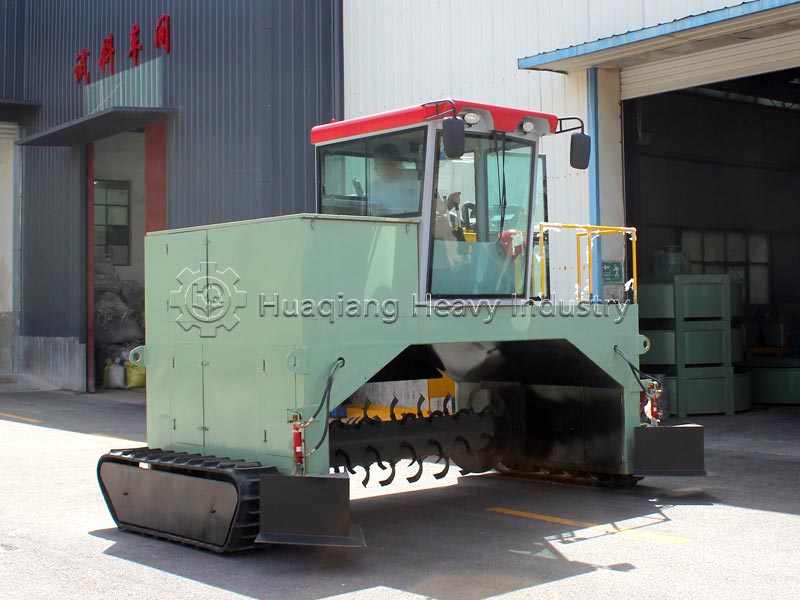
Select core parameters based on manure characteristics. For high-moisture and high-viscosity manure, prioritize equipment with high-strength, anti-sticking, and wear-resistant mixing teeth; also pay attention to oxygen supply capacity to ensure sufficient mixing of manure with auxiliary materials such as straw and sawdust, guaranteeing the porosity of the compost pile. For high-moisture materials, a double screws compost turning machine is recommended, as its helical structure provides more uniform mixing and better temperature control.
Consider site and maintenance requirements. For open-air composting, a crawler-type compost turning machine is preferred, as it is suitable for uneven terrain. In addition, prioritize equipment that is easy to operate and has a low failure rate to reduce maintenance costs, and ensure that the turning depth is adjustable to adapt to different composting stages.
In summary, the core of selection is “scale matching + characteristic adaptation + site adaptation”. By matching the high-moisture and high-viscosity characteristics of dairy cow manure with your own scale and site conditions, you can improve efficiency and optimize the fermentation environment from the root cause.