
During the fermentation of organic waste—such as livestock and poultry manure, crop straw, and kitchen scraps—several difficulties frequently arise: anaerobic conditions leading to foul odors, material clumping that hinders decomposition, site limitations, and uneven maturation. These issues compromise both the quality of the resulting organic fertilizer and operational efficiency. Leveraging its inherent advantages, the crawler-type compost turning machine offers precise solutions to effectively resolve these critical pain points.
The key to resolving the problem of anaerobic odors lies in uniform oxygenation. When materials are piled too densely, oxygen depletion easily occurs, leading to foul smells. The crawler-type compost turning machine features deep penetration and a wide turning radius; it powerfully breaks apart the compost pile, thoroughly infusing it with air to disrupt anaerobic environments and suppress odors. Simultaneously, this process stimulates the proliferation of beneficial microorganisms, thereby accelerating the maturation process.
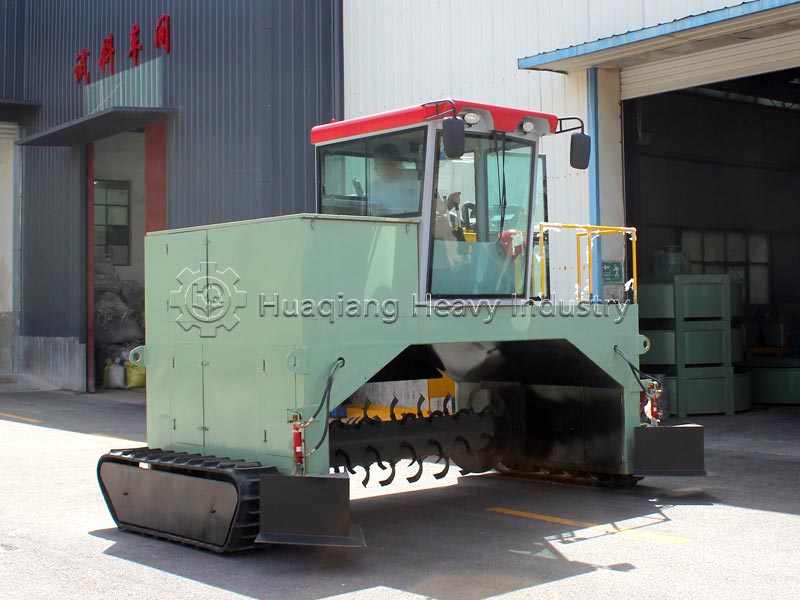
Overcoming the challenges of material clumping and uneven maturation hinges on precise turning and mixing. Materials such as straw and manure are prone to clumping; the turning teeth of the crawler-type compost turning machine are designed to powerfully break up these clumps and thoroughly blend the materials. This prevents localized unevenness in decomposition, thereby ensuring the consistent quality of the organic fertilizer.
Addressing the issue of site limitations relies on the machine’s anti-slip and anti-sinking capabilities. Fermentation sites are often muddy and soft, conditions under which standard machinery frequently gets stuck. In contrast, the crawler-type compost turning machine boasts superior traction and stable mobility; it requires no prior site leveling and can operate flexibly across a wide variety of complex terrains, thereby maximizing site utilization efficiency.
Furthermore, the machine offers exceptional mobility and operational efficiency, enabling the rapid turning of large areas while significantly reducing manual labor requirements. In summary, the windrow compost turning machine provides a comprehensive solution to the challenges of organic waste fermentation, effectively addressing critical aspects ranging from oxygenation and material mixing to adaptability across diverse site conditions.