
The core purpose of compost turning is to provide oxygen, regulate temperature, and promote microbial activity. There is no fixed standard for turning time; it needs to be determined flexibly based on raw materials, ambient temperature, and pile size. Blindly turning the compost will affect fermentation efficiency; the key is to grasp the “critical point of microbial activity.” For organic fertilizer production lines, timing is especially crucial when using equipment such as double screws compost turning machines.
There are three core influencing factors: First, the type of raw material. High-nitrogen materials (livestock and poultry manure, etc.) ferment quickly, requiring shorter turning times; high-carbon materials (straw, etc.) ferment slowly, allowing for longer intervals. Second, ambient temperature. At suitable temperatures of 25-35℃, turning times are shorter; below 15℃, longer intervals are needed. Third, pile size. A standard pile size of 1-2 meters requires moderate turning times; larger or smaller piles require adjustments.
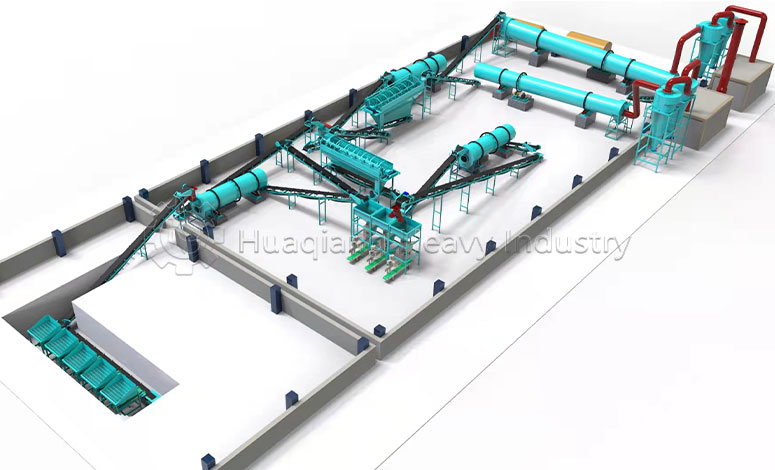
Scenario-based suggestions: For mixed compost of livestock and poultry manure + straw (carbon-nitrogen ratio 25:1-30:1), at normal temperatures, turn after 3-5 days. At this point, the pile temperature rises to around 50℃, and oxygen is nearly depleted, making it suitable for compost turning machine operation; pure straw compost requires 7-10 days before turning, waiting until the pile slightly collapses and the temperature exceeds 45℃; in winter, extend the time to 7-10 days, and after the temperature rises, use organic fertilizer production equipment to provide oxygen; in summer, shorten the time to 2-3 days to avoid anaerobic fermentation, ensuring efficient operation of the production line.
Practical reminder: In addition to observing the time, it’s crucial to observe the state of the compost pile—when the temperature rises to 50-55℃, the surface is dry and clumpy, or there is a slight sour smell, that is the best time to turn. After the first turning, adjust the frequency of equipment operation according to the temperature to ensure the pile maintains an efficient fermentation range of 55-65℃.