
At open-air organic waste treatment sites, windrow compost turning machines roar past winding stacks. This seemingly simple operation actually embodies a deep integration of sophisticated mechanical logic and fermentation technology.
Before operation begins, operators set the turning depth and travel speed based on the material properties. The advantage of windrow compost turning machines is that they require no tracks or troughs, allowing them to autonomously enter any location in the material yard. After startup, the hydraulic system drives the turning drum to descend slowly, and the rakes insert into the bottom of the stack, officially commencing the core operation.
As the equipment moves forward, the turning drum rotates at high speed, and the rakes forcefully grab and lift the hardened material at the bottom. Under centrifugal force, the material is thrown towards the rear baffle, scattering into fine particles upon impact, forming a parabolic material curtain in the air. This curtain allows the deeper material to fully contact the air, replenishing oxygen for aerobic microorganisms and simultaneously evaporating excess moisture.
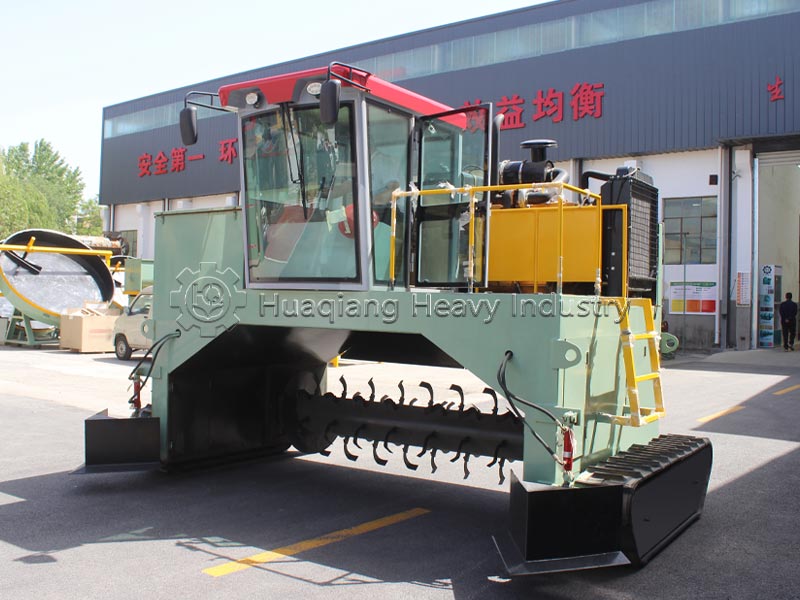
The walking mechanism advances synchronously, and the tracked chassis ensures the equipment does not slip or sink on soft material surfaces. The turning depth is typically controlled at 1.5-2 meters, completing the three-dimensional turning of the entire material pile in a single operation.
During the turning process, the equipment also functions as a mixer. If auxiliary materials or inoculants were added earlier, the vigorous turning ensures even distribution of the components, eliminating localized imbalances. After turning, the previously compacted material pile becomes loose and breathable.
Upon reaching the end of the windrow, the operator lifts the rollers, and the equipment turns in place to continue operation. The flexibility and maneuverability of the windrow compost turning machine allow it to adjust the turning frequency and depth according to the fermentation stage, precisely controlling the fermentation process.