
Among various organic fertilizer compost turning equipment, the simple trough compost turning machine is favored by small and medium-sized composting operators due to its lightweight structure. Its cost-effectiveness is highly targeted; it’s not a general-purpose, high-cost-performance device. Considering investment, operation and maintenance, and operational performance, it’s suitable for niche composting scenarios with specific needs.
The biggest advantage of this equipment is its low overall investment cost. The equipment abandons complex hydraulic and intelligent control systems, resulting in a simple structure and very affordable procurement costs. It also has low requirements for the work site, adapting to simple civil engineering fermentation tanks without requiring high site modification costs, making it suitable for production scenarios with limited budgets.
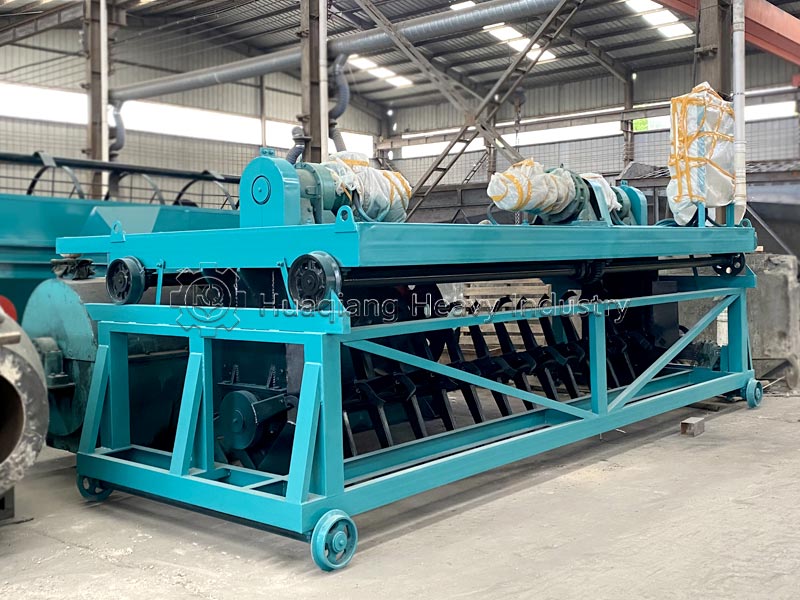
Low daily operation and maintenance costs are also a core highlight. The equipment has few parts, a stable structure, and a low failure rate, almost eliminating problems such as jamming or downtime. Replacement and repair costs are extremely low. At the same time, the machine has low energy consumption, effectively saving electricity costs during long-term continuous operation.
However, it has significant performance shortcomings and limitations. The equipment has limited turning force and depth, making it unable to handle highly moist, sticky, and easily agglomerated materials. Furthermore, its low level of automation and mediocre operating efficiency make it completely unsuitable for large-scale, high-standard organic fertilizer production lines.
In summary, the simple trough compost turning machine is a cost-effective choice for small- to medium-sized users with limited budgets who need to process conventional materials. It is suitable for small-scale farms and individual composting operations, balancing low cost and practicality. However, for large-scale, high-quality, standardized production scenarios, this equipment is not cost-effective and is not recommended.