
Building a bio-organic fertilizer production line often presents investors with more headaches than process design. The market offers a wide variety of bio-organic fertilizer equipment, with multiple options for each stage, from turning and crushing to granulation and packaging. However, what truly determines the success or failure of a project is not the sophistication of individual machines, but whether the equipment for the entire bio-organic fertilizer production line matches the raw materials and production capacity targets. The configuration logic for equipment required for bio-fertilizer production is more important than simply comparing prices.
The first principle of the configuration logic is “process determined by raw materials.” Raw material sources vary greatly; some are primarily composed of livestock and poultry manure, while others are mainly composed of straw and fungal residue. High-fiber raw materials require powerful crushers, while high-moisture raw materials require front-end dehydration or granulation methods suitable for wet materials. If pre-fermentation is required, turning equipment is necessary; if purchased composted material is used, this can be omitted. The equipment list is not a fixed template but is derived item by item based on the state of the raw materials.
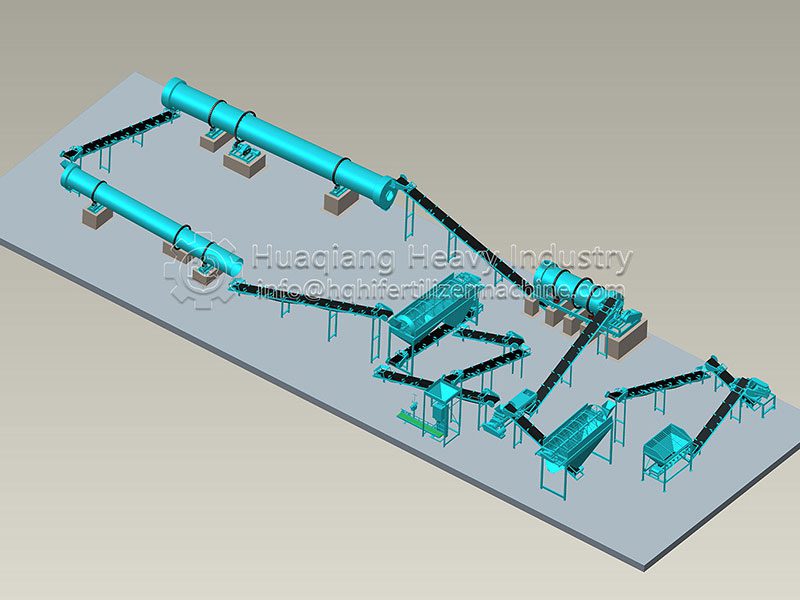
The second principle is “scale determined by production capacity.” Production lines with a capacity of 1 ton per hour and 5 tons per hour require completely different equipment models and quantities. Small-scale production lines can utilize single-machine segmented operations, connected manually or via simple conveyor belts; large-scale lines require automated batching, continuous mixing and granulation, and supporting drying and packaging. Blindly applying solutions can easily lead to energy waste or production bottlenecks.
The third point is “precision determined by product.” Ordinary organic fertilizers have relatively lenient requirements for mixing uniformity, but high-value-added bio-organic fertilizers require the addition of functional microbial agents, placing higher demands on equipment materials and hygienic design. Contact surfaces must be made of stainless steel to prevent contamination, mixers must operate at low speeds to prevent overheating, and high-temperature drying after granulation is not possible; low-temperature air drying facilities are necessary. These special requirements are often overlooked, leading to substandard microbial testing.
Auxiliary equipment is equally important. Conveyor belts, dust removal systems, and electrical control cabinets directly affect production continuity and the workshop environment. Equipment selection should follow a reverse logic of “raw materials → process → equipment.” Only when each link is matched can the entire production line operate smoothly. There is no best equipment, only the most suitable configuration.