
Equipment selection for an NPK compound fertilizer production line directly impacts overall production efficiency and costs. The rotary drum granulator is the mainstream equipment in compound fertilizer production, characterized by strong adaptability, stable granulation, and continuous operation. However, it has a fixed suitable capacity range; only by matching it to the corresponding production scale can its performance be fully utilized.
The rotary drum granulator is optimally suited for small to medium-sized NPK fertilizer production lines, with a standard suitable daily capacity range of 50 to 300 tons. Within this capacity range, the core advantage of the equipment’s rolling granulation can be fully utilized, stably processing various NPK mixed powders, producing fertilizer granules with uniformity and moderate hardness, suitable for the production of most conventional NPK fertilizer formulas on the market.
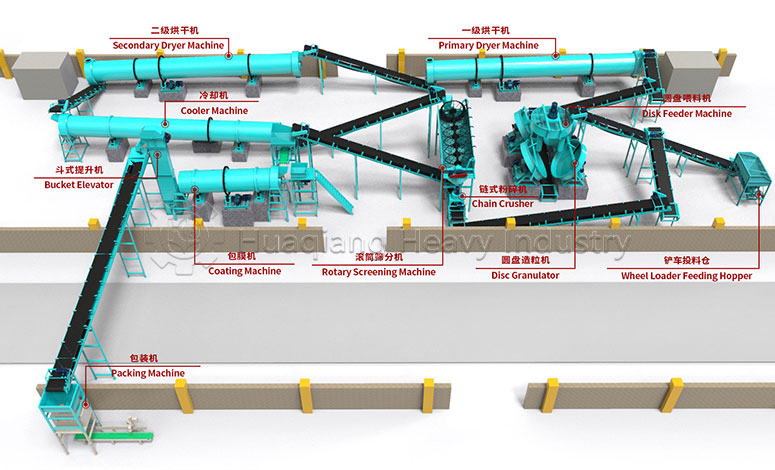
Micro-production lines with a daily capacity of less than 50 tons are not suitable for rotary drum granulators. This equipment is bulky, has high start-up energy consumption, and low-load operation will result in long-term idling, energy waste, and extremely low equipment utilization, significantly reducing the profit margin of small production lines.
Large-scale production lines with a daily capacity of over 300 tons are also unsuitable. Under ultra-high capacity operating conditions, rotary drum granulators suffer from granulation speed bottlenecks, making it difficult to match the rhythm of assembly line operations. This can lead to problems such as material accumulation and poor granulation quality, hindering their ability to meet the demands of large-scale standardized production.
In summary, rotary drum granulators are the preferred equipment for small- to medium-scale NPK production lines with a daily capacity of 50–300 tons. Micro-production lines can be equipped with small granulation equipment, while large production lines require high-capacity dedicated granulation equipment. Precise selection is crucial to balancing production efficiency and cost.