
Chain compost turning machines, with their advantages of deep trench operation and uniform turning, are widely used in large-scale composting. However, many practitioners wonder if they have limitations. The answer is yes—every piece of equipment has its application boundaries, determined by its own structural characteristics. These limitations can be avoided by identifying the right application scenario.
The limitations are mainly threefold: First, material compatibility limitations. The chain-driven turning method has poor tolerance for large, hard, uncrushed materials and heavily agglomerated sludge, easily causing chain wear. It is more suitable for processing soft, moderately decomposed organic waste.
Second, site compatibility limitations. It requires fixed deep trench operation. Although it can be equipped with a moving device, its mobility is far less than that of a windrow compost turning machine. It is not suitable for temporary composting, small sites, or scenarios without fixed fermentation tanks, requiring initial investment in site construction.
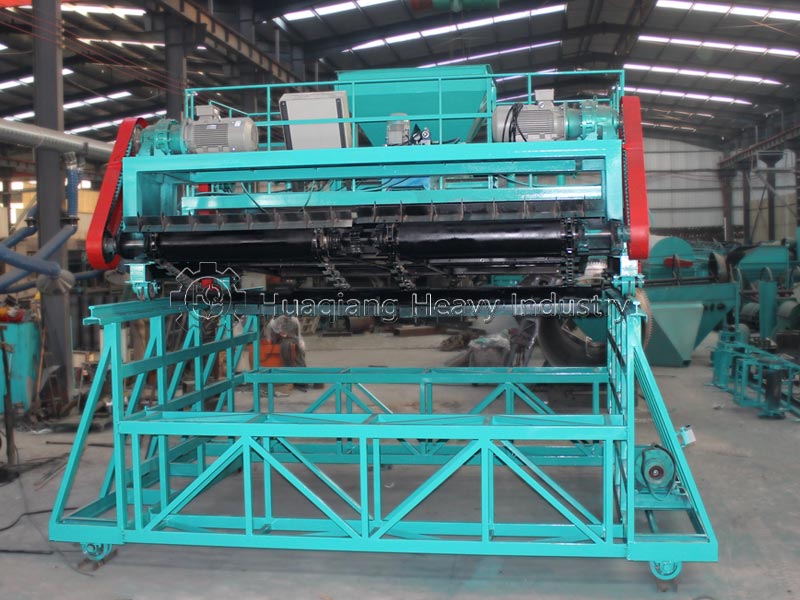
Thirdly, it has limitations in scale adaptability. Its structural design is geared towards large-scale continuous production. For small-scale individual operators, the equipment investment and maintenance costs are relatively high, making it less cost-effective than simple compost turning equipment and difficult to adapt to small-batch, intermittent composting needs.
However, these limitations can be overcome by adapting to different scenarios. Chain compost turning machines have significant advantages in deep-trough, large-scale composting scenarios, offering uniform turning and low energy consumption. In summary, while it has clear limitations, it is not unusable; by selecting the right application scenario, its value can be fully realized.