
While chain compost turning machines are not as widespread as tracked or large wheel compost turning machines, they possess irreplaceable advantages due to their unique design. Their differences from mainstream turners lie in their comprehensive structural design, operational performance, and adaptability to various scenarios.
Structurally, it uses chain drive as its core, with the turning and threshing components being linked chain plates. This distinguishes it from tracked turners (tracked) and large wheel turners (disc turners) by its compact structure. Combined with a moving device, it can achieve multi-trough operation, offering far greater flexibility than fixed-trough turners.
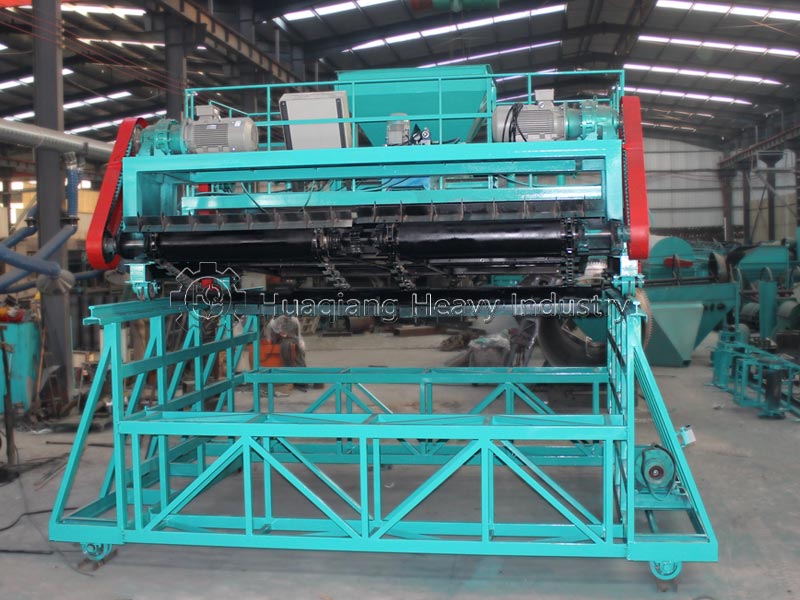
In terms of performance, its uniqueness lies in its deep-trough adaptability and uniform turning and threshing. It can operate in troughs 1.5-3 meters deep, turning the bottom layer of material layer by layer without dead corners. Furthermore, it features low turning resistance and low energy consumption, making it suitable for handling highly moist and sticky materials—advantages that tracked and large wheel turners cannot match.
In terms of application scenarios, it differs from the simple trough type suitable for small-scale individual farmers and the large disc type for large-scale windrow composting. It is more suitable for deep-trough fermentation and large-scale organic fertilizer production lines, enabling continuous and standardized operations while balancing efficiency and quality.
In summary, the unique features of the chain compost turning machine lie in its chain-driven structure, deep-trough operation performance, and precise scenario adaptation. While not an all-around machine, it can compensate for the shortcomings of other models in specific scenarios, making it the preferred equipment.