
Many composting practitioners believe that hydraulic trough compost turning machines have limited applications, but this is a misconception. While not an all-rounder, its application boundaries depend on the site, production scale, and material characteristics. Finding the right scenario allows it to leverage its core advantages.
The so-called “limitations” are inherent to its structure. It requires a fixed fermentation tank, necessitates initial site construction, and lacks flexibility, making it unsuitable for temporary composting or confined spaces. Furthermore, the hydraulic system requires slightly higher maintenance, making it less cost-effective than simpler equipment for small-scale operators.
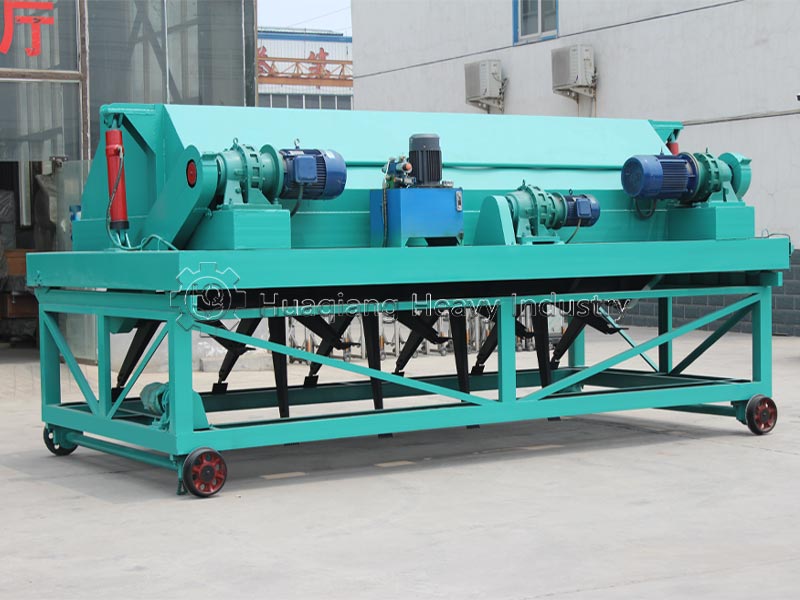
However, these “limitations” are precisely its advantages. The hydraulic drive is powerful, the turning depth is adjustable, and it can handle highly moist and sticky materials, achieving a much higher degree of composting uniformity than simpler equipment. The fixed tank allows for continuous, standardized production.
Hydraulic trough compost turning machine has a wide range of applications, processing livestock manure, sludge, straw, etc. With a transfer device, it can operate in multiple tanks simultaneously, breaking the limitations of fixed tanks. The so-called “limitations” are merely unsuitability for temporary, small-scale composting without a fixed site, not a narrow application range for the equipment itself.
In summary, the hydraulic trough compost turning machine is not limited in its applications, but rather precisely suited to specific needs rather than being universally applicable. Its high efficiency and stability are fully realized when matched with scenarios such as fixed sites and large-scale production.