
Large wheel compost turners are widely used in large-scale windrow composting, and their stable operation relies on the coordinated operation of their core components. Understanding these core components allows for a quick understanding of their operating principles and facilitates daily maintenance.
The disc assembly is the core working component, consisting of a hub, turning blades, and reinforcing plates. The blades are spirally distributed, wear-resistant, and corrosion-resistant. During operation, they rotate at high speed, turning, breaking up, and mixing materials while simultaneously supplying oxygen, directly affecting the turning effect.
The drive system is the power core, consisting of a motor, reducer, and transmission mechanism. The motor provides power, which is reduced by the reducer and then drives the disc to rotate through the transmission mechanism. The speed can be adjusted as needed to adapt to the turning requirements of materials with different textures.
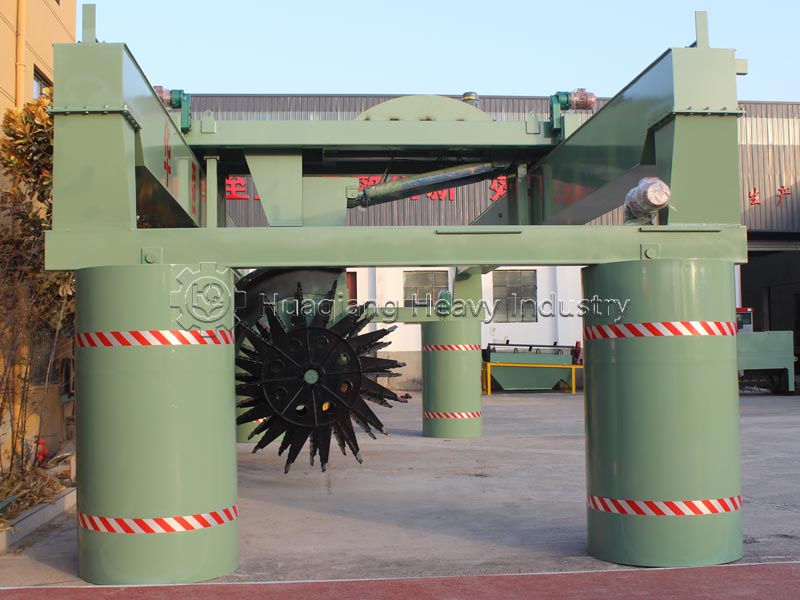
The walking mechanism determines the flexibility of the large wheel compost turning machine, and it is divided into wheeled and tracked types. Wheeled types are suitable for flat sites and move quickly; tracked types have strong traction, are suitable for soft and muddy sites, and can flexibly adjust the working position to meet the needs of large-area windrow composting. The frame and control system provide auxiliary support. The frame is made of robust materials, supporting all components and ensuring stable operation; the control system is easy to operate, allowing for start/stop and speed adjustment, and can be operated by a single person.
In summary, the large wheel compost turning machine has a simple structure and strong practicality. The disc, drive, travel mechanism, frame, and control system work together to achieve efficient and flexible compost turning.