
An organic fertilizer production line consists of multiple interconnected machines. The crawler-type compost making machine, cage fertilizer crusher, and new type organic fertilizer granulator correspond to the three core processes of fermentation, crushing, and granulation, respectively. These three machines work in sequence, collectively determining the efficiency of the entire line and the quality of the final product.
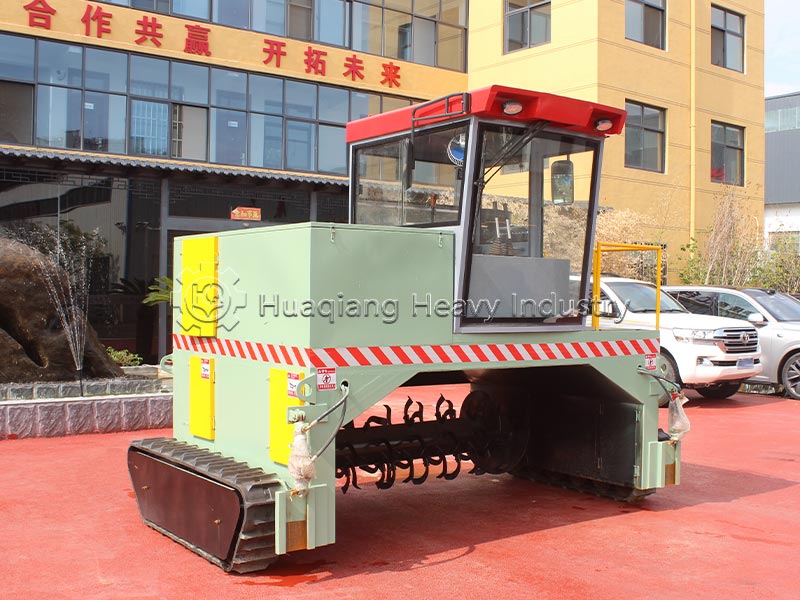
The first step in organic fertilizer production is aerobic fermentation. The crawler-type compost making machine utilizes a rubber track drive system, allowing it to operate on soft, muddy compost sites without slipping or sinking; it works directly on windrows on the ground, eliminating the need for fixed fermentation tanks. Its turning drum lifts material from the bottom to the surface, breaking up clumps and replenishing oxygen, thereby creating an active environment for aerobic microorganisms to decompose the organic matter.
After fermentation and maturation, materials often contain clumps and fibrous tangles, resulting in uneven particle sizes; direct granulation would make it difficult to ensure a high pelletization rate or adequate granule strength. The cage fertilizer crusher employs a “dual-cage collision” design, where inner and outer sets of cage bars rotate at high speeds in opposite directions, pulverizing the material through impact as it moves from the inside out. This produces a uniform output, providing an ideal powdered base for the subsequent granulation stage.
Once pulverized and refined, the material enters the granulation stage. The standout feature of the new type organic fertilizer granulator is its ability to process materials with high moisture content; fermented chicken or pig manure can be granulated directly without intensive drying. It achieves a granulation rate of over 90%, producing spherical granules.
Viewed as a whole, these three machines are inextricably linked: inadequate turning leads to persistent clumps after crushing, while incomplete crushing directly impacts the granulation rate. Solid performance in the initial stages is essential for the smooth operation of the subsequent processes.