
Recently, the chain compost turning machine supplied by our company entered the core installation phase at the Zhejiang Datong straw resource utilization project site. The assembly of the main equipment and the laying of the tracks are proceeding in an orderly manner according to schedule, laying a solid foundation for the production line to go into operation on time. Utilizing crop straw as the primary raw material and employing a trough-style aerobic fermentation process to produce organic fertilizer, the project will enhance local straw processing capabilities and facilitate the closed-loop recycling of agricultural waste upon completion.
Installation work is proceeding systematically; the construction team has completed the anchoring and leveling of the fermentation trough tracks, and the main frame has been precisely positioned via hoisting. Technical personnel are simultaneously assembling and commissioning the chain-plate drive system, the turning tine assembly, and the electronic control unit. The team strictly controls key parameters—such as track parallelism, frame levelness, and chain-plate tension—to ensure smooth subsequent operation and uniform turning. Addressing the characteristics of straw material (which is bulky and low-density), technicians have optimized operating parameters in advance to ensure efficient deep-layer turning and uniform oxygen supply once production begins.
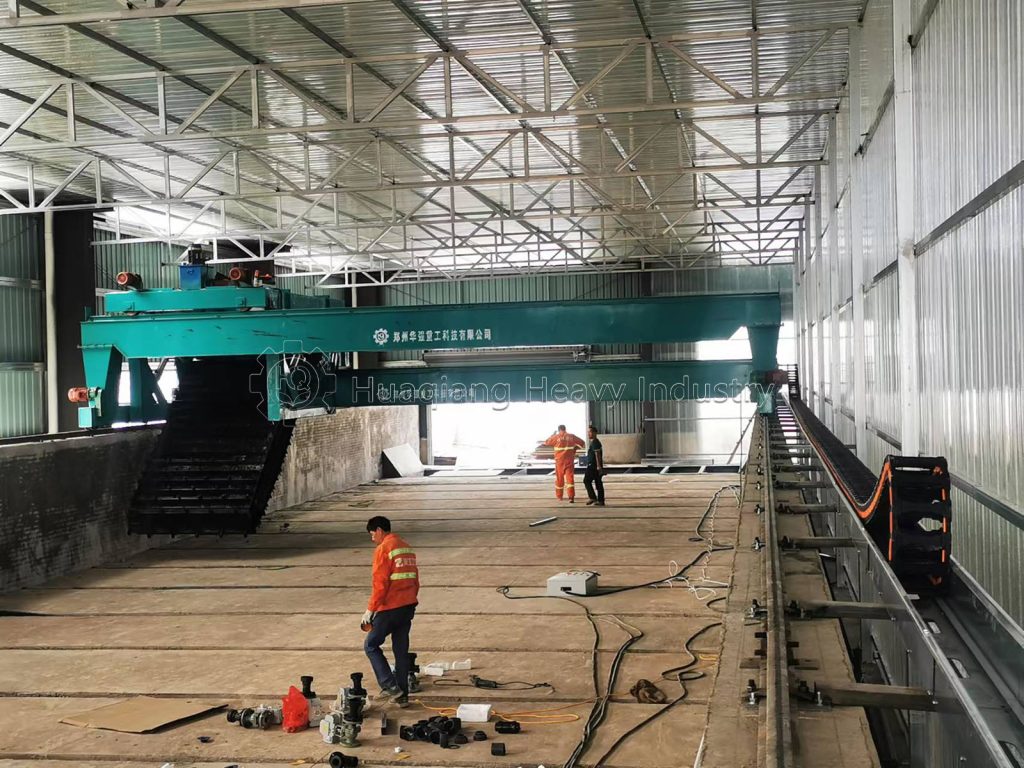
The delivered chain compost turning machine is designed for large-scale trough fermentation scenarios and effectively shortens the straw fermentation and decomposition cycle. Its core components are made of wear-resistant alloy steel, capable of withstanding long-term material friction and impact; the equipment also offers low energy consumption and easy maintenance, making it highly suitable for the project’s large-scale straw processing requirements.
We have dispatched senior engineers to provide on-site guidance throughout the process, collaborating with the local construction team to advance the work while simultaneously conducting operational training. Following installation, no-load test runs and material-loaded commissioning will be carried out to ensure the equipment is stably delivered and successfully put into operation.