
With the continuous increase in the volume of organic waste treatment, how to efficiently complete the fermentation of tens of thousands of tons of material has become a real challenge for many enterprises. The large wheel compost turning machine, with its superior large-scale operation capabilities, is gradually becoming the core equipment for large-scale fermentation projects.
The design of the large wheel compost turning machine directly addresses the core needs of large-scale production. Traditional equipment, limited by its operating width, often requires multiple units to cover large-span piles. The large wheel compost turning machine, however, uses a symmetrical arrangement of large-diameter discs, allowing a single machine to operate at a width of 20-30 meters and a turning depth of 1.5-3 meters, truly achieving highly efficient operation with “one-time travel, full coverage.”
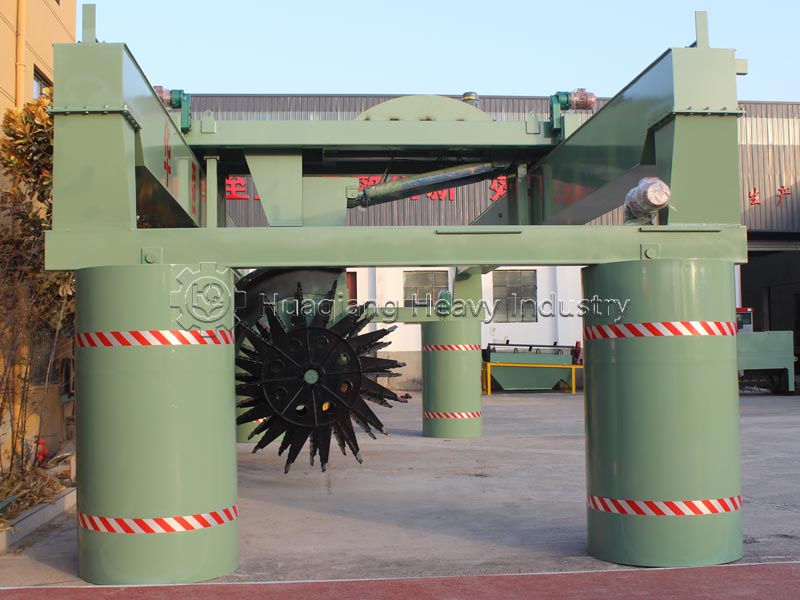
From a technical perspective, its advantages are reflected in three aspects. First, its powerful penetration capability. The heavy-duty discs, combined with high-strength turning teeth, can penetrate deep into the bottom of the pile to turn deep materials to the surface, completely eliminating anaerobic areas and ensuring uniform fermentation. Second, its significant energy-saving effect. With the adoption of an energy-saving transmission structure, energy consumption can be reduced by 70% compared to traditional equipment for the same workload. Furthermore, it boasts a high level of automation. Equipped with a hydraulic lifting system and intelligent control unit, it can automatically adjust operating parameters according to material characteristics, achieving unmanned continuous operation.
In application areas, the large wheel compost turning machine is particularly suitable for processing large quantities of organic waste such as livestock and poultry manure, municipal sludge, and kitchen waste. Taking a sludge treatment project as an example, after introducing this equipment, the average daily processing capacity of a single unit reached 32,000 cubic meters, the fermentation cycle was shortened from 45 days to 32 days, and labor costs were reduced by 75%.