
Investors in new bio-fertilizer plants often assume that simply purchasing the necessary equipment is sufficient; however, in actual production, the sequence of equipment required for bio-fertilizer production configuration and the method of execution are often more critical than the equipment itself. This is particularly true for the turning and crushing stages: if the order is reversed or the transition between steps is mishandled, the live microbial inoculants added later may fail to survive.
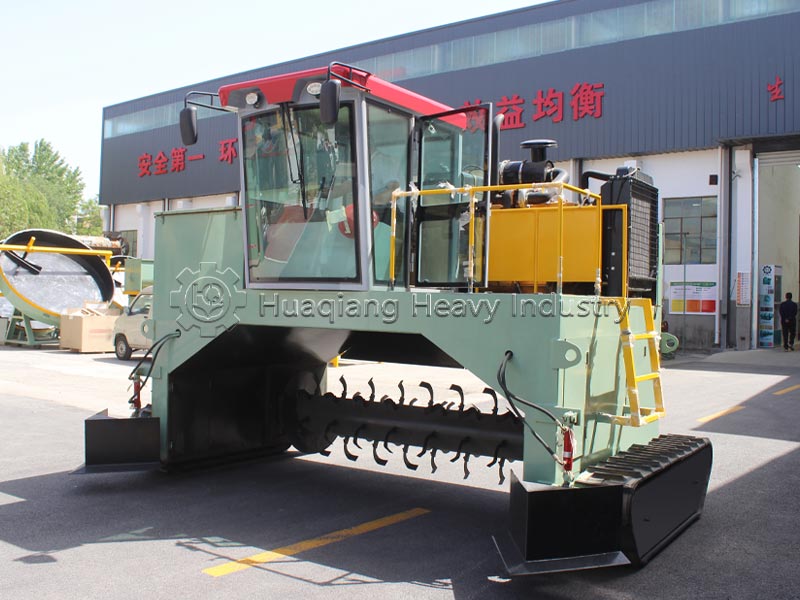
The standard bio-fertilizer production process involves fermentation followed by crushing. Some manufacturers, however, crush insufficiently decomposed materials; the resulting fine powder generates heat during subsequent stockpiling, causing temperatures to exceed 70°C and killing off the majority of the inoculated microbial agents. The crawler-type compost making machine is the key piece of equipment for ensuring thorough fermentation. Moving along the windrows on rubber tracks, the turner’s drum lifts material from the bottom to the surface while breaking up clumps; this ensures uniform temperature and adequate oxygen levels, keeping aerobic bacteria active to fully decompose organic matter and eliminate pathogens. If the turning frequency is inadequate, the material’s decomposition level becomes inconsistent—a flaw that cannot be remedied in later stages.
The crushing process following fermentation also requires a specific sequence. Some manufacturers crush the material into a fine powder before adding microbial agents, but the heat generated by friction causes the material to overheat. The correct approach is to first perform coarse crushing to break up clumps, then inoculate with microbial agents, and finally decide whether a second, fine-crushing step is needed based on granulation requirements. The cage fertilizer crusher, used for fine crushing, features a cage-style rotor design that effectively shears fibrous materials and offers superior temperature control compared to high-speed hammer mills, thereby minimizing the impact of heat generation on the microbial agents.
The root cause of inconsistent bio-fertilizer quality often lies not in the precision of the final mixing or granulation equipment, but in the neglect of the proper fermentation and crushing sequence. Thorough fermentation should be achieved first using a crawler-type compost making machine, followed by moderate fine crushing with a cage crusher, before proceeding to the mixing and inoculation stage. Only when the process flow is correct can the equipment deliver its full value; simply piling up equipment without regard for the proper sequence yields poor results despite the effort.