
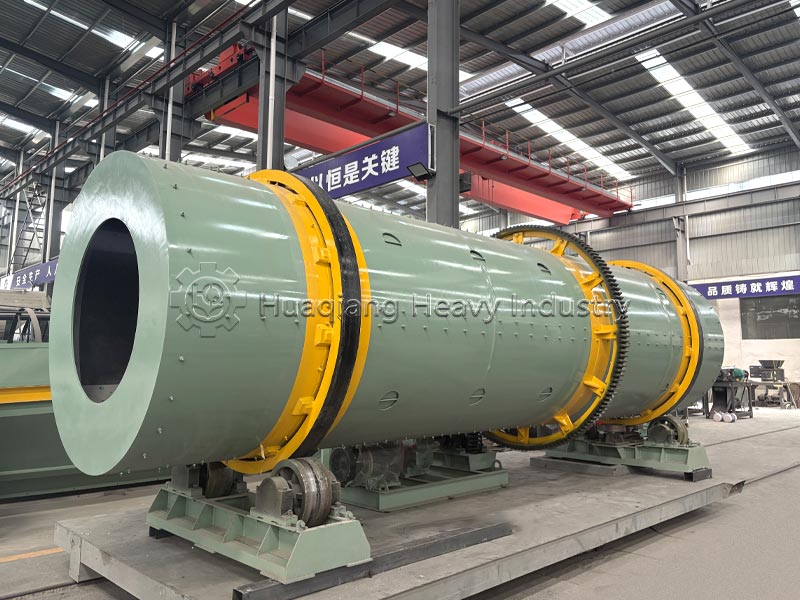
A complete rotary drum granulation production line comprises multiple stages. While the rotary drum granulator is the core forming equipment, its operational efficiency depends heavily on the quality of upstream material preparation. The crawler-type compost making machine and the cage fertilizer crusher serve as two critical components that ensure the supply of suitable raw materials for the granulation stage.
Positioned at the very beginning of the production line, the crawler-type compost making machine facilitates the aerobic fermentation of raw materials. Organic wastes—such as livestock manure and crop stalks—require thorough decomposition before granulation; incompletely decomposed materials are difficult to granulate and result in finished products prone to mold. Featuring a rubber crawler track system, the turner operates effectively on soft or muddy ground without slipping or sinking, eliminating the need for fixed fermentation pits. Its turning drum lifts material from the bottom to the surface, replenishing oxygen and breaking up clumps to maintain the continuous activity of aerobic microorganisms.
Fermented and decomposed materials often contain clumps and entangled fibers; feeding them directly into the granulator would compromise pelletization rates and granule strength. The cage fertilizer crusher employs a “dual-cage collision” design, where inner and outer cage assemblies rotate at high speeds in opposite directions to pulverize material through multi-stage impact. Capable of processing various materials with moisture content below 40%—and particularly well-suited for chemical fertilizer raw materials—the crusher produces a uniform output, creating an ideal powder base for rotary drum granulation.
Viewed as a whole, the production line relies on the compost turner to ensure decomposition quality, the crusher to refine the material, and the rotary drum granulator to achieve final pellet formation. These three pieces of equipment are interconnected; only with solid upstream preparation can the entire line consistently produce high-quality fertilizer with uniform granules.